
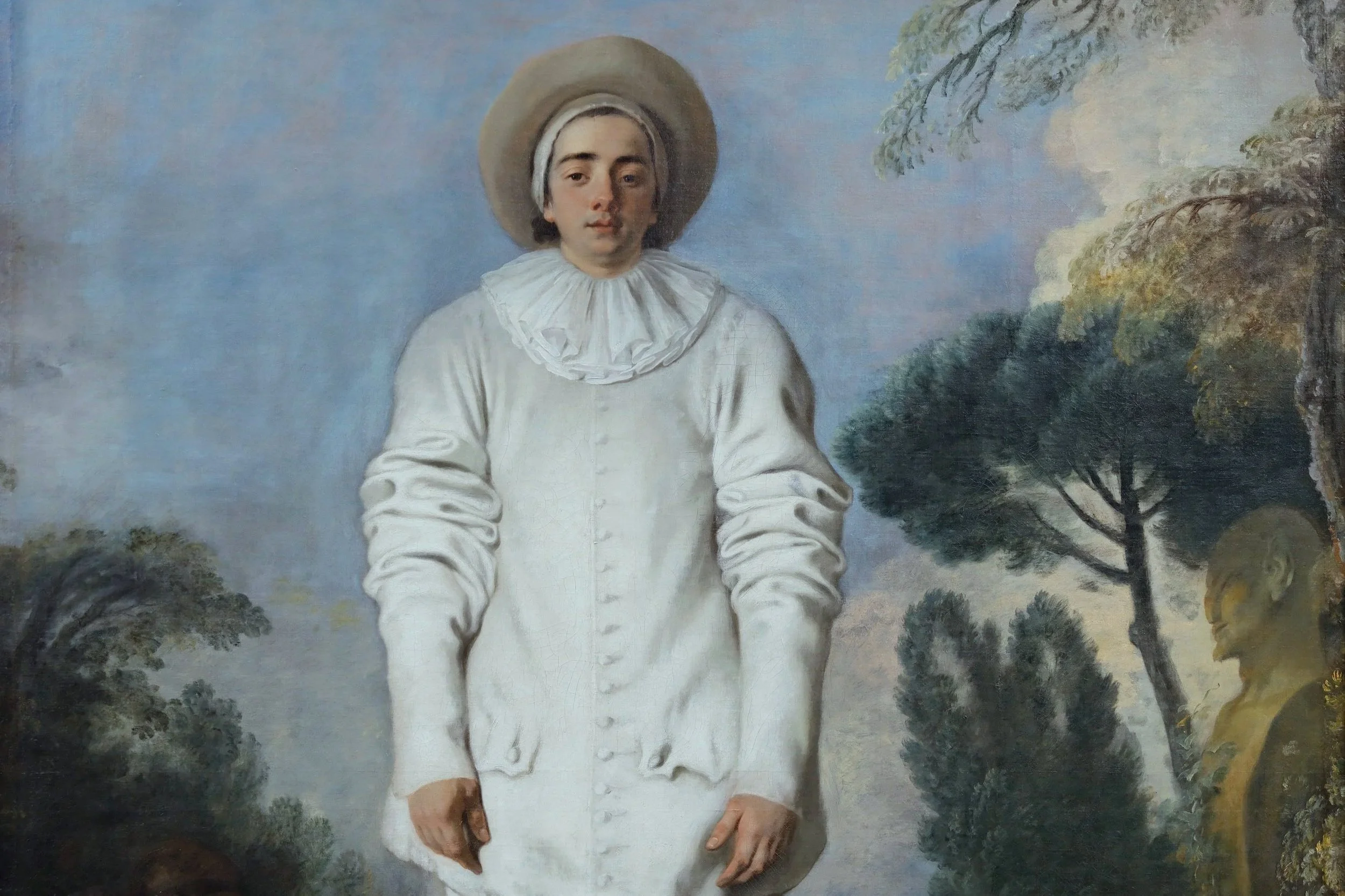
Detail of Pierrot, formerly called Gilles, Jean Antoine Watteau, about 1718 to 1719. Louvre, Paris. Image via Wikimedia Commons, public domain.
Most fathers I know have a wardrobe. Not of clothes. Of costumes.
We put them on in the morning. Sometimes we forget to take them off at night. Some of us have worn them so long that we think they are our skin.
Where the costumes come from
Nobody hands them to us on purpose. We pick them up from our own fathers. From films, from work, from the quiet rules about what a man should be. Many of us were wearing them long before we became fathers.
In my last post, I wrote about the alpha wolf, and the wolves that only fought for rank because they were locked in. The costumes are part of our enclosure.
The provider
Always working. Always a little worried about money. He shows his love in hours, not in presence. Underneath, there is often a fear: am I enough?
The protector
The fearless one. Strong, calm, never shaken. He carries everyone's worries and shows none of his own. Underneath, there is fear too. He has just learned to keep it out of sight.
The perfect one
He never makes mistakes. Or, more honestly, he never admits them. Underneath, there is shame. The old feeling that if he gets it wrong, he is wrong.
The one with all the answers
He always knows. He never says, I don't know. Underneath, there is a fear of losing respect, of being seen as small.
What the costumes protect
Every costume protects something. Usually fear, or shame. That is why I don't see them as enemies. They were the best way we found to stay safe. And many were passed down to us with love, by fathers who wore the same ones, and their fathers before them.
What they cost
But a costume can't really hug. It can't play on the floor. It can't say sorry.
Our children don't need the costume. They need us. And they notice the difference, even when they are very small. A child who only ever meets the costume learns one thing: one day, he will have to wear one too.
What changed in me
I know these costumes from the inside. The one I reach for most is the perfect one. For years I thought that was what a good father does. Slowly, I am learning that my children don't need me to know everything. They need me to be honest, to be present, and to come back when I get it wrong.
The invitation our children bring
Children don't ask us to be perfect. They ask us to be there. Imperfect, with ups and downs, with shadows and light. That is their invitation: to stop being the father we think the world expects, and to become who we truly are.
For me, this is what confidence means. Not knowing I will get everything right. But acting from my inner truth. And when a mistake comes, owning it, repairing it, and moving on.
You don't have to burn the wardrobe
Some costumes are useful sometimes. Protecting your family is real. Providing matters. The question is not whether you ever wear them. The question is: do you choose the costume, or does the costume choose you?
A small practice for this week
Before you walk through the door, stop for a moment. Notice which costume you wore today. Give it a name, silently. Then imagine taking it off, like a coat, and hanging it by the door. One slow breath, with a longer exhale. Then walk in as you.
A question to take with you
Which costume do you wear most often, and what is it protecting?
…
If this speaks to you, the next Fathering Journey starts on Tuesday, January 12, 2027. Seven evenings online, at 20:00, with ten to twelve other men. Leave your name on the waiting list and we will talk.