
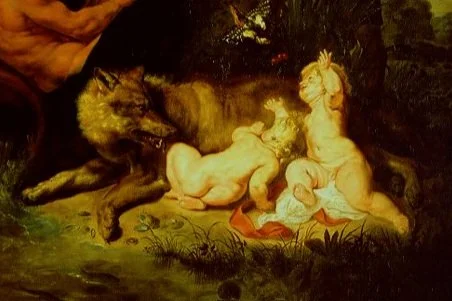
Detail of Romulus and Remus, Peter Paul Rubens, about 1615 to 1616. Capitoline Museums, Rome. Image via Wikimedia Commons, public domain.
For most of my life, I carried a picture of what a strong man looks like. Maybe you carry it too. The leader of the pack. The one on top. The one who dominates, never doubts, and never shows weakness.
A big part of that picture comes from a story about wolves. And the story is wrong.
Where the alpha came from
In the 1940s, an animal behaviourist named Rudolf Schenkel watched wolves living in the zoo in Basel. They were adults who were not related, put together in an enclosure. They could not leave. They had no family. So they fought. Some rose to the top and kept the others down. Schenkel called them the alphas.
In 1970, a young biologist named David Mech wrote a book about wolves. It became a classic. And it carried the idea of the alpha wolf far beyond science, into how many of us think about being a man.
What the wild showed
Then Mech spent decades watching wolves in the wild, including many summers in the Canadian Arctic.
What he found was simple. A wild wolf pack is a family. A mother, a father, and their young. Both parents raise the young. The so called alphas are simply the mother and the father. The father doesn’t fight his way to the top. He leads because he is the parent. He provides. He protects. He stays close to the young ones.
The fights for rank turned out to be mostly what happens when wolves are taken out of their natural life.
Mech has spent years correcting his own work. He asked his publisher, again and again, to stop printing his famous book.
What changed in me
When I first heard this, something in my chest softened. The strongest wolf in the pack is not the one who wins the fight. He is the one who feeds his family and keeps them close. For me, this was life changing. It gave me permission to see care as strength, and to trust that this is closer to who we are than the picture I grew up with.
What is our captivity?
If wolves only fight for rank when they are locked in with strangers, I have to ask: what is our enclosure?
Maybe it is the long hours that keep us away from home. The pressure to provide and never fail. The fear of being seen as weak. Learning to be a father alone, without a village around us. A culture that keeps selling us the alpha as the model of a man.
And maybe the hard, controlling father many of us knew was not a man in his natural state. Maybe he was a man in captivity. That doesn't excuse what he did. But it helps me see the man behind him, and the boy he once was.
A word of honesty
Wolves are not people. I am not saying there is one natural way to be a man. The wolf story is a mirror, not a proof. But it is a mirror worth looking into.
A small practice for this week
Notice one moment when you reach for control. Raising your voice. Needing the last word. Needing to be right. Pause there. Feet on the ground, one slow breath with a longer exhale. Ask yourself silently: what would care look like here, instead of control? Then choose.
A question to take with you
What is the captivity in your life that keeps you from the father you want to be?
Further reading
L. David Mech, 1999. Alpha status, dominance, and division of labor in wolf packs. Canadian Journal of Zoology. https://pubs.usgs.gov/publication/1001725
A short video where Mech explains why "alpha" is no longer accurate: https://www.youtube.com/watch?v=tNtFgdwTsbU
…
If this speaks to you, the next Fathering Journey starts on Tuesday, January 12, 2027. Seven evenings online, at 20:00, with ten to twelve other men. Leave your name on the waiting list and we will talk.